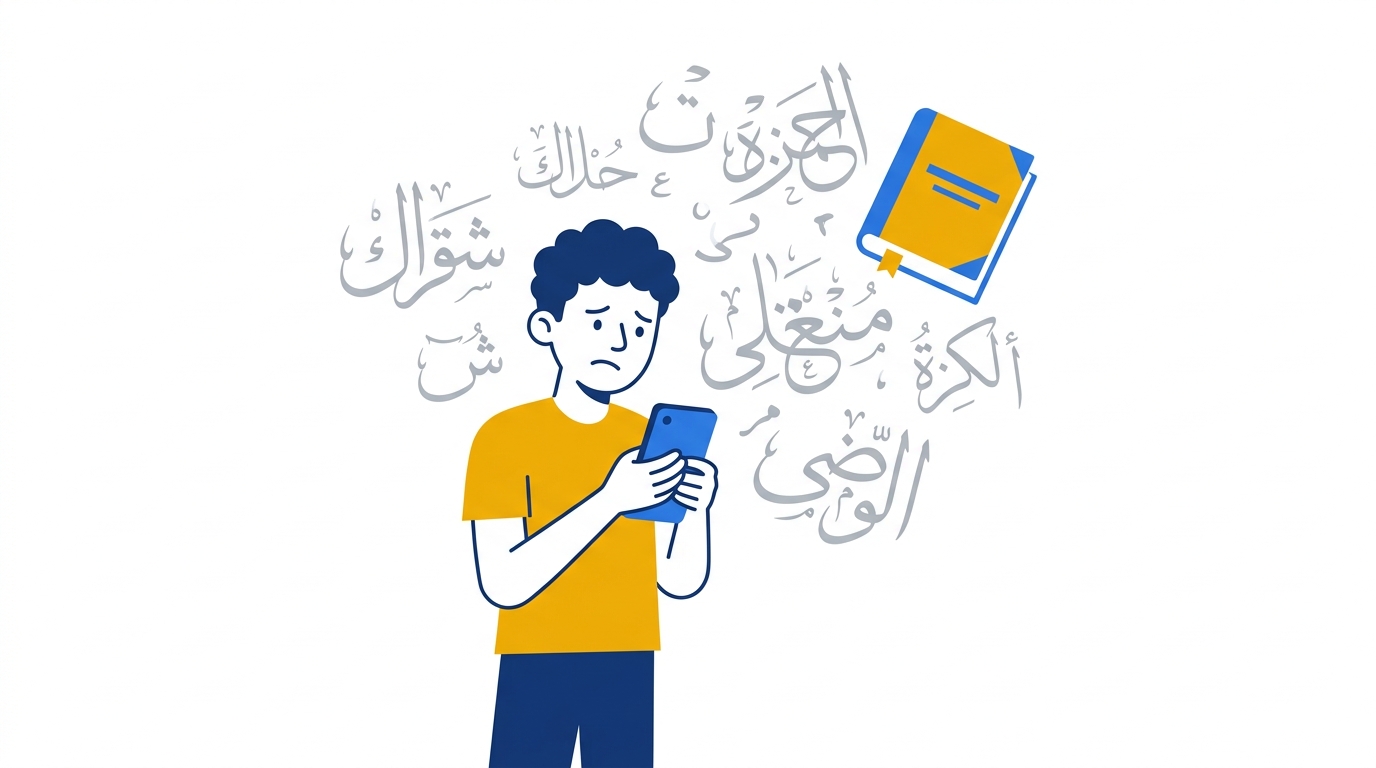
If you’ve spent any time Googling “Why is Arabic so confusing?”, you have probably stumbled upon massive Reddit threads filled with frustrated learners.
They all share the exact same story: They spent six months practicing Arabic every day on a language app. They memorized the alphabet. They learned the grammar rules. Then, they sat down to watch an Arabic show on Netflix—and realized they couldn’t understand a single word. Even worse, the subtitles didn’t seem to match what the actors were saying at all.
You might have also read articles listing all the reasons Arabic is “the hardest language in the world”—the right-to-left cursive script, the missing vowels, the complex gendered plurals, and the guttural sounds.
If you are feeling overwhelmed, take a deep breath.
Arabic is not broken. You are just being taught the wrong language.
The “MSA Trap” Explained
When you download a generic language learning app (like Duolingo or Rosetta Stone) or enroll in a standard university course, you are almost always taught Modern Standard Arabic (MSA), also known as Fusha.
MSA is a highly formal, academic language. It is the language of the news, literature, legal documents, and official speeches. It is beautiful and mathematically precise.
But here is the massive secret the apps don’t tell you: Nobody speaks MSA natively.
If you walk into a coffee shop in Amman, Beirut, or Cairo and order a drink using the MSA you learned on Duolingo, people will understand you, but they will look at you like you just walked out of a Shakespeare play.
The Reddit users who are frustrated that the Netflix subtitles don’t match the audio are experiencing this exact disconnect. The subtitles are translated into formal MSA, but the actors on screen are speaking their natural, everyday dialect.
The Solution: The Spoken Dialects (Amiya)
If your goal is to pass a literature exam or become an international diplomat, you must learn MSA. But if your goal is to actually speak to people—to travel, make friends, or talk to your partner’s family—you need to learn a spoken dialect (called Amiya).
The most widely understood and useful dialects are Levantine Arabic (spoken in Palestine, Jordan, Lebanon, and Syria) and Egyptian Arabic.
Read our deep-dive into the history and beauty of Palestinian Arabic here!
Why Dialects are the Ultimate Shortcut
Those intimidating articles listing the “9 Reasons Arabic is Hard” are talking exclusively about MSA. When you switch to a spoken dialect, the language suddenly becomes incredibly accessible:
- Forget the missing vowels: You don’t need to read unvoweled, right-to-left cursive text just to hold a conversation. You can learn to speak entirely through transliteration (using English letters) and voice notes.
- Simpler Grammar: The rigid case endings, complex conjugations, and dual forms of MSA are almost entirely dropped in daily speech.
- More Forgiving: Locals don’t care if your grammar is mathematically perfect. They care about connection, warmth, and the cultural context of your words.
Stop studying. Start speaking.
The reason Arabic feels so confusing right now is that you are trying to learn a written, formal language to have a casual, verbal conversation.
Stop memorizing archaic vocabulary you will never use. Switch your focus to a spoken dialect like Levantine or Egyptian, and you will find yourself holding your first 15-minute conversation in weeks, not years.